Ceramic insert casting
Specificatiion
DJM采用金属陶瓷颗粒为增强相、合金钢(或高铬铸铁/高锰钢)为基体金属、利用稀土元素提高耐磨材料金属基体的强度,在耐磨材料易磨损部位熔铸增强相-陶瓷颗粒预制体,熔铸过程中基体金属与合金化后的陶瓷颗粒在金属液高温作用下实现冶金结合、从而获得硬度呈阶梯分布的金属基陶瓷复合层。
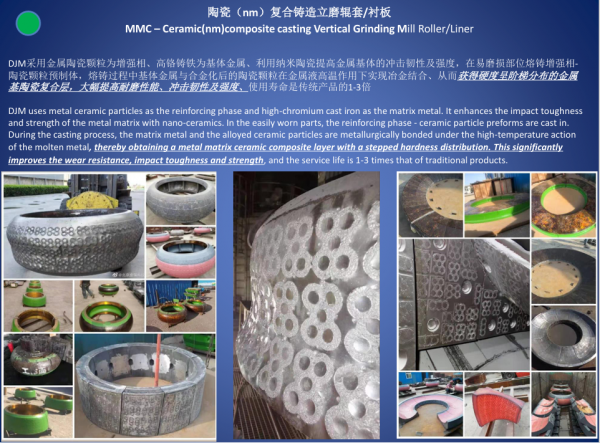
DJM uses ceramic particles as the reinforcement phase, alloy steel (or high chromium cast iron/high manganese steel) as the matrix metal, uses rare earth elements to improve the strength of the metal matrix of wear-resistant material, and fuses the reinforcement phase - ceramic particle preform in the wear-resistant material. In the process of melting casting, the matrix metal and alloyed ceramic particles achieve metallurgical bonding under the action of metal liquid at high temperature, so as to obtain the metal matrix ceramic composite layer with ladder hardness distribution.
陶瓷本身具有耐高温、高硬度、高耐磨、抗氧化的性能,陶瓷颗粒弥散分布于金属基体中极好解决了两相热膨胀不一致的问题,合金化后的陶瓷颗粒与基体金属实现冶金结合解决陶瓷颗粒脱落的问题,陶瓷颗粒及预制体的蜂窝结构形态有效控制复合层厚度并实现大面积复合; 基体金属冶炼过程中加入稀土元素细化晶粒,改善碳及碳化物形态,增强基体金属强度,提高冲击韧性及焊接性能,在保持金属基材原有性能的基础上大幅提高其耐磨性能; 复合材料层的耐磨性能是高铬材料的3-4倍,同时复合材料层厚度可达原零件厚度的1 / 3以上,适合在高冲击、高磨损条件下使用,可焊接可再加工,满足恶劣工况条件下的耐热抗氧化耐磨要求。
The ceramic itself has the properties of high temperature resistance, high hardness, high wear resistance and oxidation resistance. The ceramic particles are dispersed in the metal matrix to solve the problem of inconsistent thermal expansion of the two phases. The alloyed ceramic particles and the matrix metal realize metallurgical combination to solve the problem of ceramic particles falling off. The honeycomb structure of ceramic particles and preforms can effectively control the thickness of composite layer and realize large-area composite. In the smelting process of matrix metal, rare earth elements are added to refine grains, improve the morphology of carbon and carbide, enhance the strength of matrix metal, improve the impact toughness and welding performance, and greatly improve the wear resistance of metal substrate on the basis of maintaining the original performance of metal substrate. The wear resistance of the composite layer is 3-4 times that of the high chromium material, and the thickness of the composite layer can reach more than 1/3 of the thickness of the original part, which is suitable for use under high impact and high wear conditions, and can be welded and reprocessed to meet the requirements of heat resistance, oxidation resistance and wear resistance under harsh working conditions.





 Tel: +86-10-8890 9291 MP: +86-13901376361
